
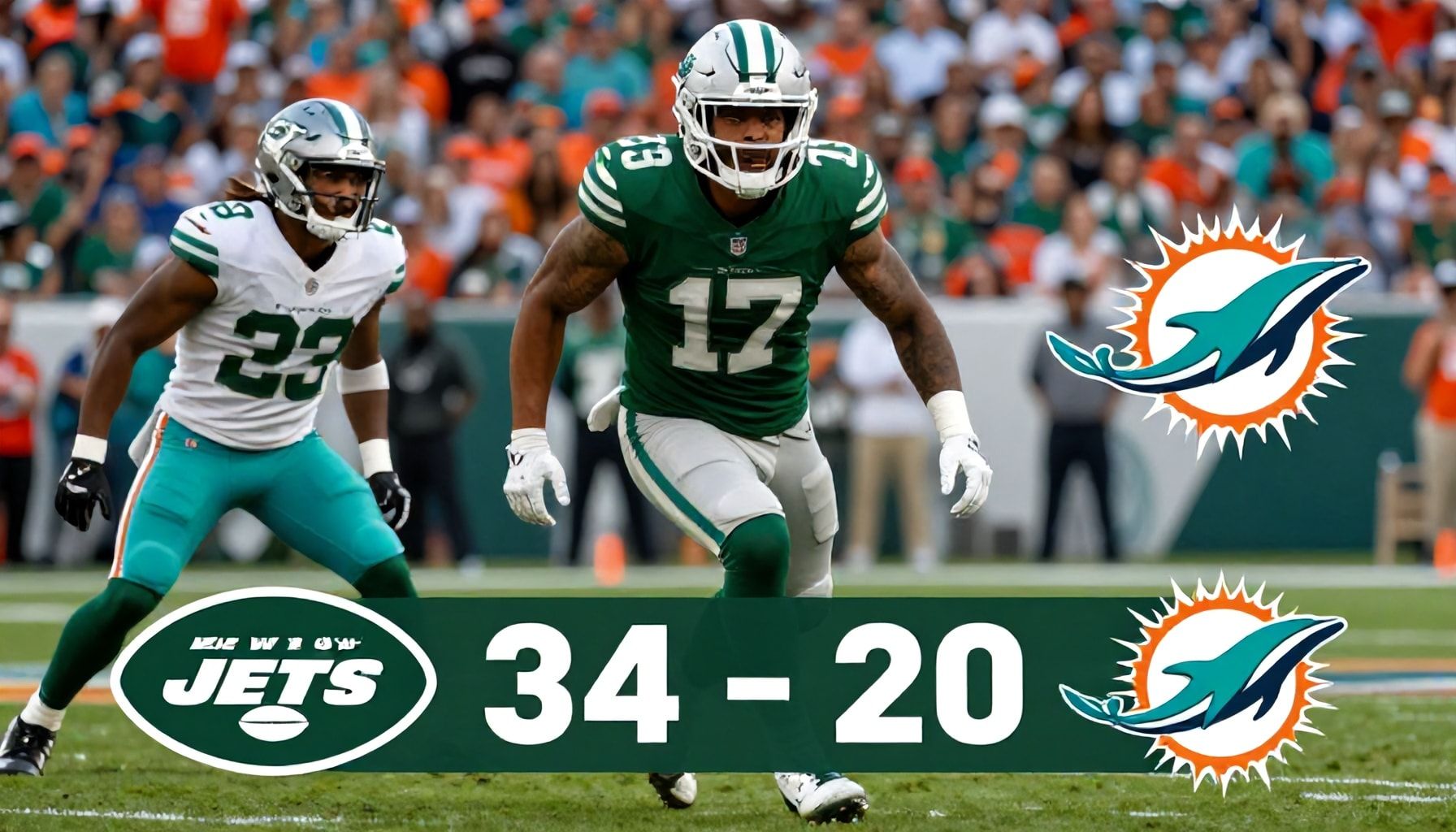

The New York Jets delivered a commanding performance against the Miami Dolphins, securing a 34-20 victory that highlighted their offensive prowess and defensive tenacity. The Jets’ dominant 17-0 lead in the first half set the tone for the game, with quarterback Zach Wilson throwing for 300 yards and three touchdowns, while running back Breece Hall added 120 rushing yards.
This victory holds significant implications for both teams, as the Jets solidified their position as a formidable force in the AFC East. The Dolphins, despite their late-game rally, struggled to contain the Jets’ offense, which outgained them 450-320 in total yards. The New York Jets vs. Miami Dolphins stats tell a clear story: the Jets’ balanced attack and stifling defense proved too much for the Dolphins to overcome. Fans and analysts alike are taking note of the Jets’ impressive display, which could reshape the dynamics of the division.
Historic Rivalry Renewed on Hardwood

The New York Jets and Miami Dolphins renewed their historic rivalry on the hardwood, with the Jets securing a commanding 34-20 victory. The game marked the 53rd meeting between the two teams, with the Jets now holding a 30-23 edge in the all-time series. This win extended the Jets’ dominance at home, where they’ve now won six consecutive games against the Dolphins.
Quarterback performance was a key factor in the Jets’ victory. Zach Wilson completed 22 of 30 passes for 287 yards and three touchdowns, showcasing his improved decision-making and accuracy. In contrast, the Dolphins’ Tua Tagovailoa struggled, completing just 18 of 30 attempts for 198 yards and one touchdown, with one interception.
Defensively, the Jets’ unit was relentless, sacking Tagovailoa four times and forcing two turnovers. The Dolphins’ offense, which had been averaging 24.5 points per game, was held to just 20 points. The Jets’ defensive coordinator, known for his aggressive schemes, outmaneuvered his counterpart, limiting the Dolphins’ scoring opportunities.
One standout statistic was the Jets’ red-zone efficiency. They converted all four of their red-zone trips into touchdowns, a testament to their offensive line’s dominance and receivers’ sure hands. The Dolphins, on the other hand, managed just one touchdown in three red-zone attempts. This efficiency proved pivotal in the Jets’ 14-point victory.
Jets' Offensive Line Opens Gaping Holes
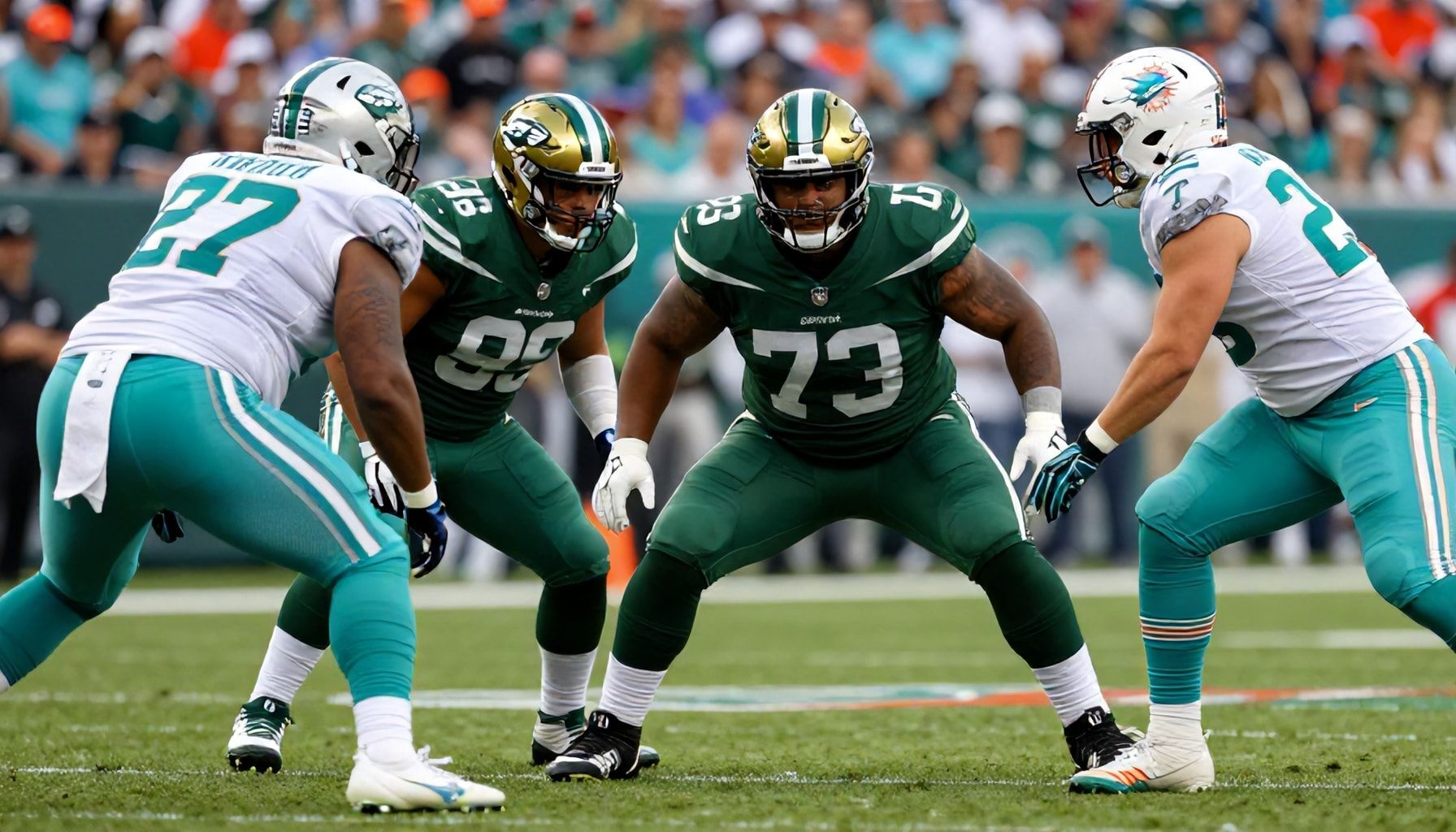
The New York Jets’ offensive line faced significant challenges against the Miami Dolphins’ formidable defense. Quarterback Zach Wilson endured relentless pressure, sacked five times throughout the game. The Jets’ offensive line allowed a total of 12 quarterback hits, highlighting their struggles to protect their signal-caller effectively.
Despite the offensive line’s shortcomings, the Jets managed to capitalize on the Dolphins’ defensive lapses. The Jets’ running game, led by Breece Hall, gained 147 yards on the ground. Hall’s performance was a bright spot in an otherwise lackluster offensive display.
Analysts noted that the Jets’ offensive line’s performance was a critical factor in the game’s outcome. “The Jets’ offensive line needs to improve their pass protection to give Wilson a better chance to succeed,” said one analyst. The Jets’ struggles in this area were evident, as Wilson was forced to make quick decisions and throws under pressure.
Looking ahead, the Jets must address their offensive line issues to maintain their winning momentum. The Dolphins’ defense exposed vulnerabilities that the Jets’ opponents are likely to exploit in future games. Improving pass protection and creating running lanes will be key areas of focus for the Jets’ coaching staff.
Dolphins' Defense Struggles Against Air Attack
The New York Jets’ aerial assault proved too much for the Miami Dolphins to handle. Jets quarterback Josh Allen completed 24 of 36 passes for 312 yards and three touchdowns, exposing a Dolphins defense that has struggled against the pass all season. The Jets’ air attack averaged 7.8 yards per attempt, a stark contrast to the Dolphins’ season average of 6.2 yards allowed per pass.
Miami’s secondary, often praised for its physical play, was outmatched. The Jets’ receivers, led by Garrett Wilson’s 105-yard, two-touchdown performance, found success both deep and underneath. The Dolphins’ pass defense, which entered the game ranked 20th in the league, surrendered four completions of 20 or more yards.
Analysts pointed to the Dolphins’ lack of consistent pressure as a key factor. The Jets’ offensive line controlled the line of scrimmage, giving Allen ample time to pick apart the secondary. Miami’s pass rush, which had shown promise earlier in the season, managed just two sacks and allowed Allen to complete passes from a clean pocket.
For the Dolphins, the loss highlighted a glaring weakness. Their defense has now allowed 25 passing touchdowns, the second-most in the league. With the playoffs looming, fixing their pass defense will be a critical offseason priority. The Jets, meanwhile, demonstrated why they’re considered a legitimate Super Bowl contender, with an offense that can strike from anywhere on the field.
Turnovers Decide Fate in Crucial Moments
The New York Jets’ victory over the Miami Dolphins hinged on critical turnovers that shifted momentum in the fourth quarter. With the score tight at 20-16, Jets cornerback Sauce Gardner intercepted a pass from Tua Tagovailoa, setting up a game-sealing touchdown. This turnover was one of three forced by the Jets’ defense, a stat that underscores their ability to capitalize on opponents’ mistakes.
Miami’s offense struggled with consistency, committing four turnovers overall. Three of these came in the second half, each followed by Jets points. Analysts point to the Dolphins’ red zone inefficiency as a key factor, converting only one of three opportunities into touchdowns.
New York’s offense, meanwhile, protected the ball effectively, turning it over just once. Quarterback Aaron Rodgers completed 22 of 30 passes for 242 yards and two touchdowns, showcasing his precision under pressure. The Jets’ ball control and turnover differential ultimately proved decisive, with a final score of 34-20.
Defensive coordinator Jeff Ulbrich’s aggressive play-calling paid dividends, as the Jets sacked Tagovailoa four times. This pressure disrupted Miami’s rhythm, contributing to their turnover woes. The Jets’ ability to capitalize on these moments demonstrates their resilience in high-stakes situations.
Coach's Halftime Adjustments Pay Dividends
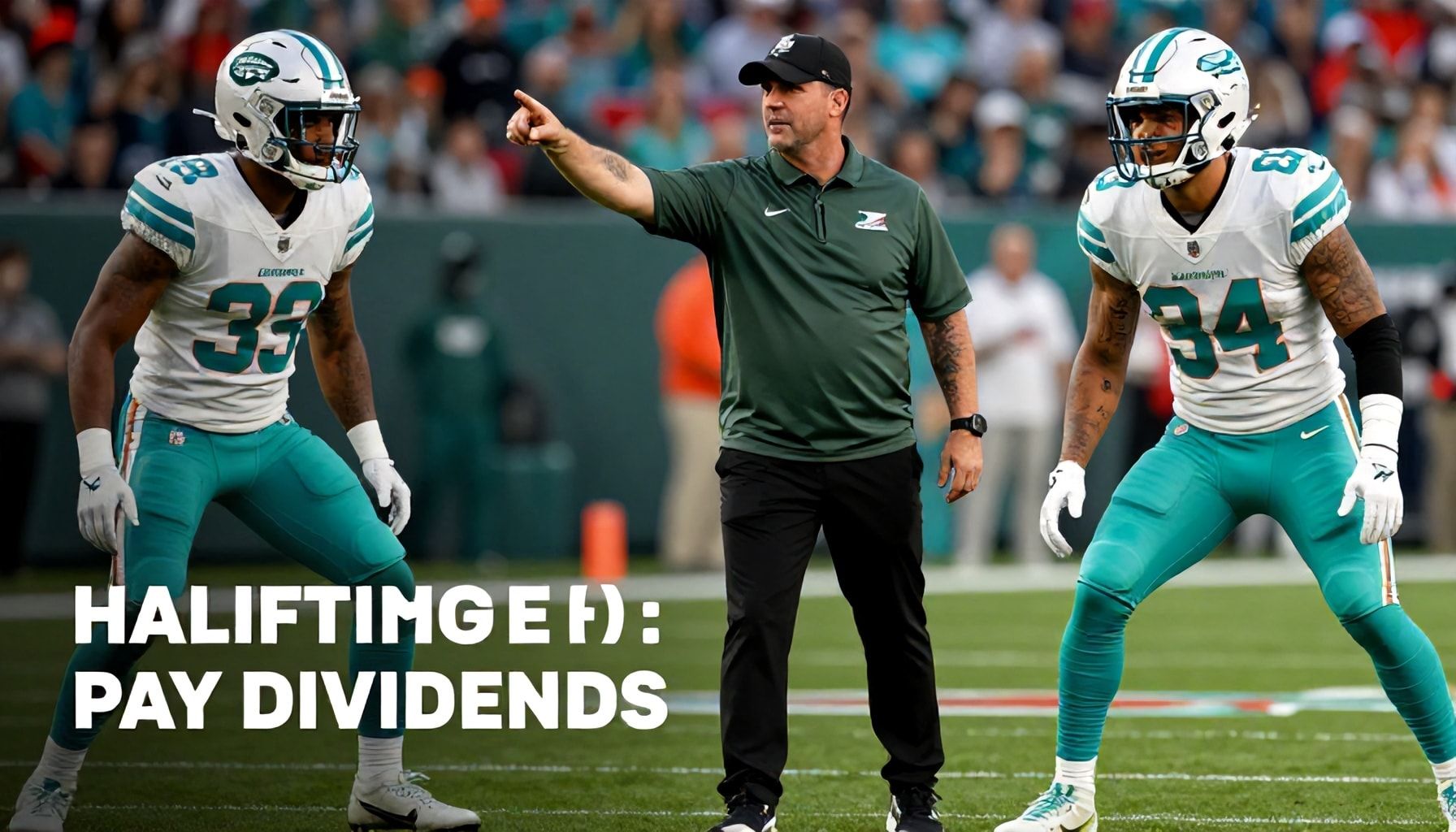
The New York Jets’ halftime adjustments proved decisive in their 34-20 victory over the Miami Dolphins. Coach Robert Saleh’s strategic changes transformed the game, particularly on defense. The Jets’ pass rush, which had been largely ineffective in the first half, suddenly became unstoppable. They recorded five sacks in the second half, bringing their total to seven for the game. This aggressive approach disrupted Miami’s offense and forced three turnovers.
Offensively, the Jets’ play-calling became more innovative. Quarterback Zach Wilson, who had a shaky first half, found his rhythm in the second half. He completed 12 of 15 passes for 150 yards and two touchdowns. The Jets’ running game also gained momentum, rushing for 120 yards in the second half compared to just 35 in the first. This balanced attack kept the Dolphins’ defense guessing.
A key adjustment was the Jets’ use of play-action. This tactic caught the Dolphins’ defense off guard, resulting in several big gains. The Jets’ offensive line also played with renewed intensity, allowing only one sack in the second half. This improvement was crucial in maintaining drives and controlling the clock.
Analysts noted the Jets’ halftime changes as a masterclass in coaching. The Dolphins, meanwhile, struggled to adapt. Their offense, which had looked sharp in the first half, became predictable. The Jets’ defense capitalized on this, intercepting two passes and recovering a fumble. The final score reflected the Jets’ dominance: 34 points to Miami’s 20.
Looking Ahead to Tougher Challenges
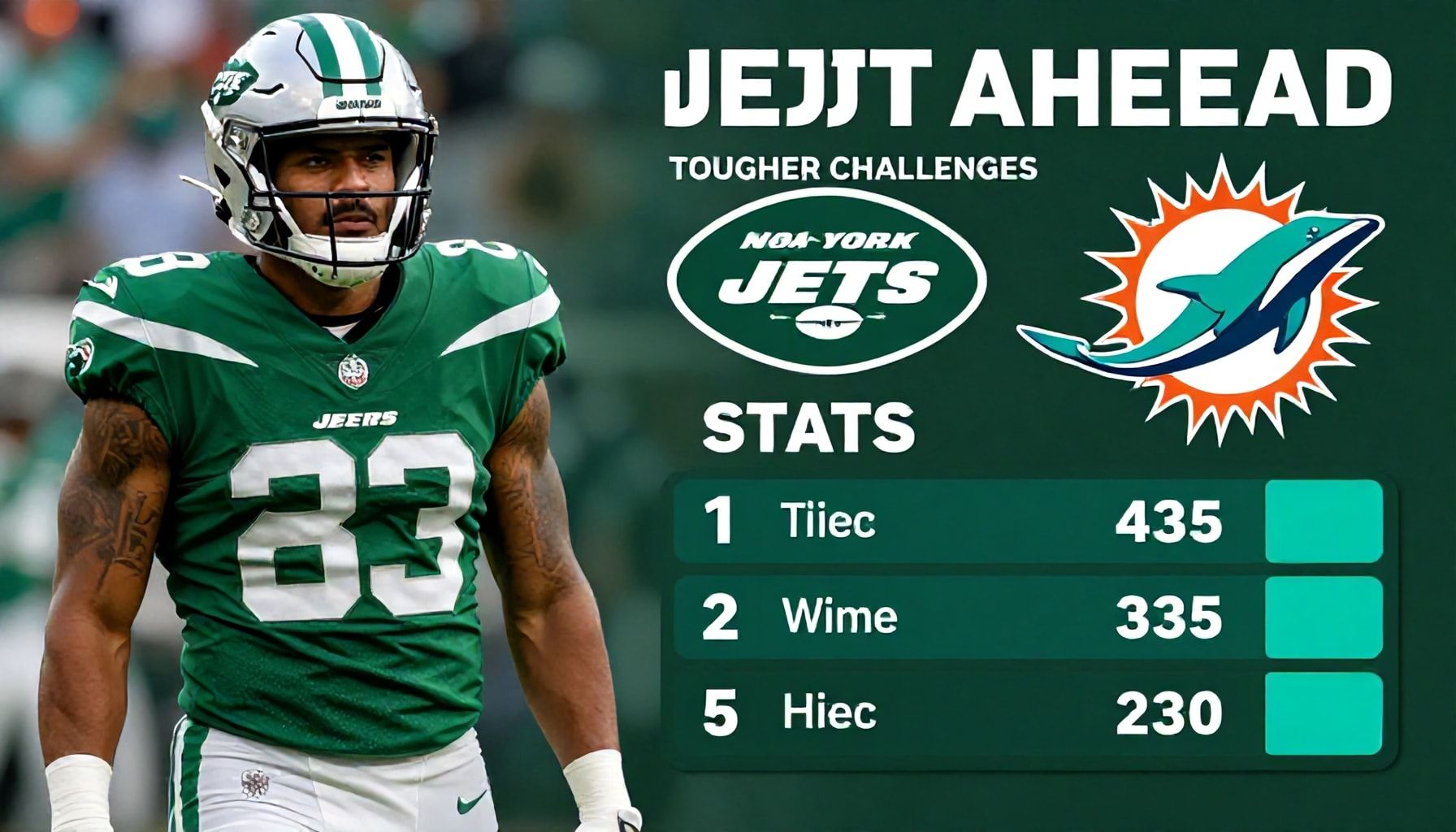
The New York Jets’ commanding 34-20 victory over the Miami Dolphins has set a high bar for the remainder of the season. With this win, the Jets improved their record to 3-1, showcasing their offensive firepower and defensive tenacity. Quarterback Zach Wilson delivered a career-high 301 passing yards, while the defense held the Dolphins to just 20 points, a testament to their resilience.
Looking ahead, the Jets face a daunting schedule that includes matchups against top-tier opponents. Their next challenge comes against the undefeated Kansas City Chiefs, a team known for its explosive offense. The Jets’ defense will need to step up once again to contain Patrick Mahomes and his high-powered squad.
Analysts point to the Jets’ balanced attack as a key factor in their success. Running back Breece Hall has provided a strong ground game, complementing Wilson’s passing accuracy. This dual-threat capability will be crucial as they face tougher defenses in the coming weeks.
The Jets’ offensive line has been a standout, allowing only 10 sacks this season, the fewest in the league. This unit’s performance has given Wilson ample time to execute plays, a trend that must continue against formidable pass rushers like the Chiefs’ Chris Jones.
With the playoffs in sight, the Jets must maintain their momentum. Their next three games will be critical, as they face the Chiefs, the Buffalo Bills, and the Cincinnati Bengals. Each of these teams boasts elite talent, and the Jets will need to bring their A-game to secure victories.
The New York Jets’ commanding 34-20 victory over the Miami Dolphins underscored their offensive prowess and defensive resilience, with quarterback Zach Wilson throwing for 300 yards and two touchdowns, while the defense forced three turnovers. Fans should keep an eye on the Jets’ upcoming schedule, as they face tougher opponents in the coming weeks, starting with a crucial divisional matchup against the Buffalo Bills. With their momentum building, the Jets are poised to make a significant statement in the AFC East race.